Two Control Methods, Same Goal
Every stabilizer in this category exists to do one thing: keep output voltage steady at roughly 220V despite whatever the incoming grid supply is doing. But look closely at the product attributes and you’ll notice two different approaches listed across the Stabimatic range — “Servo Motor Based” control systems, and units simply labeled as an “Automatic Voltage Regulator (AVR).” Both correct voltage automatically; they just do it with different internal mechanisms, and that has practical implications for precision and use case.
Servo Motor Control
Servo-based stabilizers use a motor-driven variable transformer that continuously adjusts to track the input voltage. In this catalogue, that includes compact units like the Stabimatic 500C Servo Motor Voltage Stabilizer SF-500VA (Rs. 10,528) and STABIMATIC SD-1000C Servo Stabilizer 1000VA (Rs. 15,266), both listing an efficiency of ≥98% and a 220V ±1% output. The servo approach scales all the way up the range too — the Stabimatic SLC-5KVA Servo Motor Control (Rs. 91,972) and the heavy-duty Stabimatic SDD-30KVA Servo Motor Control (Rs. 344,000) both use the same servo-based correction, just at industrial capacity.

Standard AVR Units
Other models in the range are simply listed under “Type: Automatic Voltage Regulator (AVR)” without a servo motor control system called out specifically — for example, the Stabimatic GL-1100C Automatic Voltage Regulator (Rs. 14,739), the Stabimatic SPD-3KVA Series (Rs. 38,070), and the Stabimatic GLD-5000C (Rs. 61,315). These still deliver automatic correction and the same 220V ±1% output with ≥98% efficiency listed in their specs, and carry the same overload, over/under-voltage, and short-circuit protection features found across the range.
Does It Matter Which You Choose?
For most home and office use, either approach delivers the core promise: steady output voltage and protection from spikes, drops, and fluctuations. Where it can matter more is in heavy-duty or industrial settings with wide voltage swings and continuous operation — which is why Stabimatic’s larger servo-based units, like the Stabimatic SDD-15KVA Servo Motor Control (Rs. 175,000), are positioned for industrial and commercial electrical systems that need to track voltage continuously over long duty cycles.
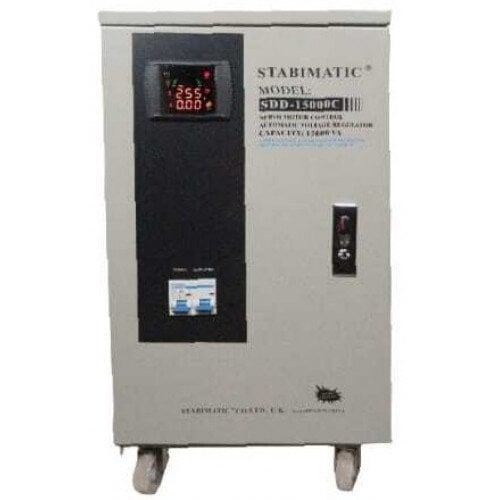
In practice, the decision usually comes down to matching the capacity (VA rating) and application (home, office, or industrial) to your actual load, then comparing price across the servo and standard AVR options available at that capacity — as with the 3000VA tier, where the servo-based STABIMATIC GLD-3000C Servo Stabilizer (Rs. 31,584) and the standard AVR Stabimatic SXD-3000C (Rs. 34,914) sit close together on price.
Frequently Asked Questions
What does “servo motor based” mean on a stabilizer’s spec sheet?
It means the unit uses a motor-driven variable transformer to continuously correct voltage. Models like the Stabimatic 500C and SD-1000C list this as their control system, alongside a ≥98% efficiency rating.
Are standard AVR units less effective than servo models?
Not based on the listed specs — standard AVR units like the Stabimatic GL-1100C and SPD-3KVA carry the same 220V ±1% output and ≥98% efficiency figures as the servo-based models in this catalogue.
Which technology is used in the largest industrial units?
The largest units here, the Stabimatic SDD-15KVA (Rs. 175,000) and SDD-30KVA (Rs. 344,000), both use servo motor control, positioned for industrial and commercial electrical systems.
Do both types carry the same protection features?
Protection features vary by series rather than by servo vs. AVR classification — most models in this catalogue list overload protection plus either thermal/surge suppression or over/under-voltage and short-circuit protection, depending on the specific line.
Leave a Reply